Showing posts with label Ashtanga. Show all posts

Sunday, March 29, 2015

Yoga Practice After Hysterectomy Surgery

It’s been about 7 months since my hysterectomy surgery and I’m slowly returning to my Ashtanga practice.  Practice has been a bit unscheduled, and by that I mean I’m not able to do physical asana every day yet.  On the days that I don’t do asana, I use the time slot in its entirety for my Lenten meditation with Mona Lisa.   My practice partner slid easily into our old morning practice routine and particularly enjoys the off-days because of the extended lap time.  

Back in January, I started with a sun salutations A and B, closed with the 3 lotus flowers and savasana.  By mid to late January, I added in the standing postures and headstand every few days.  Since I no longer have “ladies holidays”, I have peppered in my rest days in between moon days and Saturdays based on how my still healing body feels.  Speaking of which; I’d heard that Sunday was now a rest day, so I tried practicing on Saturdays for about 2 weeks before I settled back into the Sunday practice rhythm.  Old habits...

As far as led classes go, I take led primary classes on Thursdays and Sundays, which are so enjoyable after so much time off.   I really missed seeing everyone, the cozy warmth of the studio and the familiar sound of bare feet on hardwood.   I’m still on teaching hiatus except for the occasional sub opportunity, so that means there’s play time!  Oh how sweet it is to pop in on a week night or a Saturday morning vinyasa class for a little free stylin’. 

Fast forward to a few weeks ago, I attended my first full led primary class..  Physically, it was a command performance.  Making all jump backs and managing the arm balances somewhat gracefully.  However, about 2 hours later I found myself on the couch curled up with China Gel and Advil with my teacher Keith's voice in my head saying "skip some jumpbacks".   I slept in on Monday.

What have I noticed about my physical self since returning to yoga since surgery?

  1. I have I have more room in my belly!  Folds and twists that hit a wall before have greater range of movement.   The growing solid bulk of the fibroids were really been doing a number on me.
  2. I’m light.  My hips don’t feel nearly as heavy and I’ve managed to float once or twice.
  3. Upper body strength seems in tact  but it’s my legs that get wobbly and my calves that burn.  I notice this mostly in vinyasa classes.  Also, my upper abs felt sore a lot initially but this has begun to subside.
  4. My focus is much more intense.  I’ve never had much trouble with dristi, but it seems even more focused now.

What have I noticed mentally since surgery?

  1. I'm in absolutely NO RUSH to regain my previous practice momentum and ability.   My hysterectomy feels like a right of passage along with age (smile) to this state of mind.  I do my best to stay on schedule, but sometimes I don't and I'm OK with that.
  2. I frequently say hello to my new body during practice.  I'm still healing and have a long way to go; but at 7 months post op I've been amazed and surprised at what happens on the mat.
  3. A weight of worry has been lifted.  Gone are the embarrassing ladies holidays that crept up on me and sidelined practice at a moments notice and created a constant, anxious state of mind.

This weekend, I'm attending a mysore session with Krista Shirley’s in DC.  This will be my first mysore studio session in about 10 months, so I'm looking forward. 

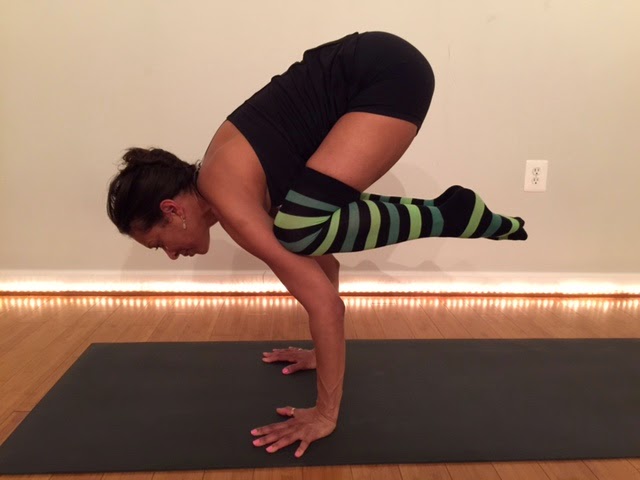
I've been taking some photos and videos of my practice to document post surgery progress mostly, and this photo was taken on St. Patty’s Day.  Found the socks when I was out shoe shopping.  I didn’t’ find any shoes, but the socks were a must have J. 


Saturday, September 20, 2014

Uterine Fibroids and Hysterectomy


I've been living with ovarian cysts and uterine fibroids for most of my life.  It started with a little pang in my right side that turned out to be an ovarian cyst back in high school.  Medication dissolved it, but ovulation from that side remained painful throughout the years.  For the most part, I didn't have any issues during my 20's except for the heavy periods that I thought were normal.  

By the time I got married in my 30's and wanted to have kids, my fibroids made their presence known in the form of even heavier and painful periods and increased comments from my OBGYN.  "You're going to have to hurry up and get pregnant," he told me.  "your fibroids are getting larger and you're not getting any younger.  Time to decide what to do with the baby shop."   Until that conversation, my position on motherhood remained at the intersection of, 'I don't want kids yet' and 'it's probably time to settle down'" and so I decided after that visit to try and get pregnant.  However, it wasn't in the cards for my then husband and me, and while we tried to figure out our lives the clock kept on ticking.

Fast forward to me approaching 40.  My fibroids had grown so large that pregnancy wasn't possible so I opted for a myomectomy to buy time.  After surgery, my doctor warned that fibroids were like weeds and that even though he was able to remove all the tumors, the uterus acts as a root and can sprout new growths.  Full recovery took a year, and in that time my marriage ended.   After relocating, I slowly began life again and unbeknownst to me for a while, the fibroids began to grow back.

Now in my early 40's, fertility was becoming an issue and it was at that time that I began to let go the hope of being able to  have children of my own naturally.   The menorrhagia returned, sometimes twice a month and I was instructed to double up on iron supplements.  Then one day, I felt what seemed like a little rock in my belly and it actually rolled around sometimes!   During my ashtanga practice paschimottanasana and marichyasana c/d were difficult because of the bulk and associated bloating.  I take 'ladies holidays' off and they seemed to never end.  Practice dwindled and the symptoms would quickly get worse.  Exhaustion from anemia set in and it was all I could do to get home and in bed most evenings after work.  Waking at 5:30 am became impossible.

The last straw was the hard bulge in my belly that became visibly noticeable and the increasing questioning glances I got when I wore form fitting clothes.   My doctor confirmed that the fibroids had doubled in size in 6 months, resulting in what looked like a 16 week pregnancy.  My bladder, bowel and spine were being compressed which brought on a whole slew of new symptoms not to  mention that I could no longer fit into most skirts and pants comfortably.  An MRI would confirm that one of the fibroids had outgrown its blood supply and developed a large cyst.  My treatment options quickly boiled down to Uterine Fibroid Embolization (UFE) and Supracervical Hysterectomy.

While in the process of making a decision, I scoured the internet for information through sites like Hystersisters, YouTube and yoga blogs.   The many posts I read helped me to understand what to expect and enlightened me to a health issue that ranks as one of the most common for women as my surgeon would confirm.  I would personally speak to 7 women in a two week period (4 of them close family members) who'd undergone hysterectomy surgery.

I chose the hysterectomy after seriously considering UFE, which would have allowed me to keep my uterus and offer some relief, but might have landed me back in the same predicament in a few years.  Menopause is still a ways off, and after 10 years of dealing with fibroids I had my quality of life to consider.  I'd gone from being very active to almost sedentary in recent months save for teaching and the few yoga practices I could manage. My boyfriend who'd been very supportive while I weighed my options confessed, "I just want you to be healthy."

My hysterectomy surgery was on August 29 and at 3 weeks post op, I'm feeling like a new creature.  Aside from the need to nap throughout the day, I no longer feel like life is being sucked out of me.   Still in bed mostly, I'm able to get around without much of a production.   Mona Lisa has been my ever constant nursing companion, supervising my boyfriend while he took care of me the first two weeks and handled household tasks on my behalf.    My doctor says I can return to moderate exercise in a few months. 

I'm writing this blog to share my story and offer support to women who are dealing with uterine fibroids.  It's common to take years to decide what to do about them for many reasons, which is understandable.  For me, I feel that even though I could have made this decision on a physical level many years ago, the emotional realizations took far longer to reconcile and I'm glad I waited in that regard.  Once I made the decision to schedule my surgery, I never once looked back.

There are a few quality of life decisions of note that I have suffered through before making.  There are many more, but these stand out:

having lasik surgery
getting a smart phone (yes, I'm serious about this one)
having a hysterectomy

The figurine pictured was a gift from long ago that has come to symbolize peace with regard to this point in my life.  At one time I thought of throwing it in the trash.  Now I'm so glad I didn't.

Tuesday, June 24, 2014

Led Primary with Kino MacGregor in DC

Back in March I had the fortune of catching a led primary series with Kino MacGregor through Woodley Park Yoga in DC.  When my daily mysore practice began almost a year and a half ago, I’d started by watching Kino’s and Sharath Jois’ Primary Series DVDs.  I've spent hours  watching Kino's videos mainly because she speaks my language when it comes to verbal cues. 

Prior to Ashtanga, I had a steady Baptiste vinyasa practice peppered with led primary classes and had developed a slow ujjayi rhythm.  When I began teaching led classes, I’d keep the same tempo while counting and occasionally heard from students that my counts were long.    Rather than compromise consistency, I maintained the slower tempo of counting which is slower than most; however, not slower than Kino’s counts.

Kinos 5 counts were 10 of mine, and the shakes set in early for me during her Led Primary class.  My hips also felt heavy during jump throughs, resulting in mat burn and a nice toenail nick on the top of my hand.  Prone to hyper pigmentation, I knew that I'd be reminded of these long counts for some time to come.  More immediate and pressing a matter, however was finishing the practice. The deconstruction of it all came during closing when my shoulders were so tired that I couldn't sustain the inversions.

I hadn’t been pushed by a teacher in the area of long counts since attending a weekend with David Robson at the Miami Life Center in 2013.  There, he used the drum beat to which he asked us to  move through sun salutations.   Since practicing with Kino, I've taken to extending my counts a little, which I didn't think would be acceptable to traditionalists until I read a recent throwback blog posted by Shanna Small  that featured excerpts from the theaspiringyogi.  If you scroll down in this interview with Manju Jois (the oldest son of Ashtanga Yoga Founder, Sri K Pattabhi Jois)  you'll see what he has to say about holding postures for longer than 5 breaths.    Basically, he says that the body begins to settle in a posture after the fifth breath.

Touche students, I feel your pain :).

* Pictured above are a some of my students who attended Kino MacGregors' March weekend workshop in DC.


Wednesday, July 24, 2013

Lessons From the Mat


Here lately I’ve begun to take notice of a lesson that’s been presenting itself over the past few months in my Ashtanga practice.  It’s about the timing of breakthroughs. 

This morning, I almost chose to sleep in versus going to mysore.  I’d gotten just little less sleep than I needed, but no less so than usual.  While my mind wasn’t chattering about it; which is usually the case, it was just a feeling I had.  Snuggling in deeper under the covers I imagined drifting off again.

10 minutes in bed with this “feeling” before I threw back the covers and got in the shower; I ended up leaving the house about 20 minutes late.    In the world of mysore, 20 minutes equals an entirely different room when you arrive.    Unmoved by this because my own obstinence was to blame, I dutifully lined up my mat up at the next available spot and began the opening mantra.  Quiet as kept, although I'll lay my mat where ever, I do have a favorite spot.

Standing sequence went a little slower and I felt OK, but when I hit the floor my “feeling” came back.  I just didn’t want to practice and my mind wasn’t giving up any explanation.  Usually when I don’t feel up to practice I can pin it on either PMS (sorry men) or some emotional trigger (PMS) but neither was the case this time.  So I went on doing my practice anyway just trying to finish. 

I’m practicing full primary now, and am content to experience it in it’s entirety while smoothing out the last few several postures.  However, today in my resignation I had no expectations of any successes above simply completing the sequence.  So I watched myself as bhujapidasana approached.  Keith was nearby, but I didn’t look up and ask for help because I just wanted it to be over.   Forward I jumped, balanced and folded, and after about 3 breaths with my feet on the ground I said screw it and mightily pointed my toes.  There I balanced with pointed toes lifted and chin hovering for 2 breaths; a moment that has been 2 months in the making.

Moving through the next set of poses went as usual until setu bandhasana which is a posture that quite frankly until about a week and a half ago could have stood between me and Second Series forever but Keith said otherwise.  I’ve been practicing it for a little over a week, and with my teachers' help is a miraculous occurrence.  On my own I can never seem to get my legs straight before I feel like I’m going to roll right over onto my face.   That would be OK if I thought I could survive it, so I've been planting my hands to prevent what seems ominously inevitable in these early stages.

Fast forward to my “feeling”.   I looked at the clock and saw that I was still 20 minutes behind – WAY late for me to be finishing on a work day.   So I crossed my arms and pushed into the pose for maybe a breath and a half and then placed my hands down to brace myself for almost 3 breaths before exiting the pose.  “That’s it!” I heard Keith say, and smiling he came over to help me into a proper repeat.

It was when I got into my car and reflected that the lesson on breakthroughs came to me.    Consistently, I’ve made advances in my practice on the days when I struggle most.  Be it inflammation, tears, or "melancholy" it’s always true.   Short of being cliché, I have to acknowledge the fact that the yoga I began practicing on my own terms has only begun to truly reward me when I practiced on its terms = on good days and bad days.

It’s often a bitter pill, but when I am in the studio having a good day and I hear an ashtangi “going through” I’m at an instant compassionate towards them, as I know they are towards me on my bad days.  Regardless of who is having what kind of day practice continues and it's in the acknowledgement of others and acceptance of myself that moves me more than anything.  Off the mat in those early hours we share with each other about how we are really doing and what is really happening in our lives.  I've had some very candid conversations before 6 AM.

The asana successes are icing on the cake.  I know I'm leaving the studio steadier, stronger, more pliable and more alive having done my practice.   And this is all on what I thought was a bad day.  Here is where my perception on what that really means is changing.


Saturday, July 20, 2013

A Letter to 36 Year Old Me


Dear 36 Year Old Me,

You’re gonna get hooked on this practice called yoga and are going to do it well into your 40s!  So go ahead and immerse yourself in it and into the yoga community.   I know you’ll stay with that basics class till the end and then begin taking all levels classes to push your limits.  Put yourself in uncomforbable places on the mat and with people, there is so much about you that has yet to be revealed (this statement doesn't make sense now, but it will after your first yoga retreat).  I know you and your girls think you’re coming into yourselves in your 30’s but you’ve got so much more to learn.

You’re gonna meet the most wonderful people in yoga classes and in workshops, some of whom will become your dearest friends for many years, including your basics teacher, Ursula.   Do sign up for workshops, retreats and yoga trips to far away lands.  Your yoga has more to teach you than just postures.  It will show you who you are, it will allow you to truly see other people and most of all yoga will teach you how to be present for your life.   I know that the reason you walked into that yoga studio was to get away from some harsh realities and decisions but yoga is going to lead you right  back into the heart of those matters pretty quickly.  Life is funny that way.

Things are going to change dramatically for you in a few years, and when life turns upsidown, yoga will be one of the few consistent things in your life that you will keep doing.   Oh, and those new yoga friends you’re going to make in addition to the ones you’ve always had will be there through it all.   Stay in touch with them even when you have to move away, not go out as much, or recover your health.

In about 5 years you will give up all meat but fish, so you’ll be saying goodbye to the “itis” and “the food baby” forever.   You grew up eating all your vegetables anyway, so you’ll adjust to this way of eating just fine.    I know you don’t eat fast food now, but the one or two times you forget yourself and get a filet o fish meal from McDonalds – because sadly you’re still going to be a non-cook in 9 years - it’ll take about two days for you make amends with your constitution.   It will take exactly 2 instances for you to get this lesson.

You’ll leave the house without blowdrying and straightening your hair – A LOT and will donate your hair rollers.

Your shoes of choice will be flip flops and UGGS, which right now I know you’d rather wear only at the pool and throw into a raging bonfire respectively.

You will have little use for your bras save for special occasions for about 3 years – more on this later.

Please don’t wait until you’ve got mounds of yoga clothes in your closet before you donate them to new yogis who don’t want to drop their paychecks at Lululemon.  You’ll keep the first pair of groove pants from there for 9 years and counting for nostalgic purposes, but the others must go.  Besides, 9 years from now you’ll be waking up so early to practice that you won’t care what you put on, as long as it’s a top and a bottom and doesn't require you to constantly adjust yourself in class.  Did I mention that you’d be practicing every day?

If you missed what I said in the previous paragraph, I’ll say it again:  you’re going to be practicing in the MORNING!  I know that you feel your body is at it’s “yoga best” in the evenings and although a morning person who considers that sacred pillow time before 6 am untouchable, you’re gonna grow to appreciate the stillness of mind that only happens before you’ve had a chance to turn on the news, check this thing called Facebook and answer emails (work and personal) and get on the phone.    You’ve yet to discover the quiet mind part yet.  That will take several years.

Here’s the shocker.  You will become a Yoga Teacher!  Completely certified.  Where will you amass the time and money for this you ask?  In 2008, you’ll find yourself with a nice severance package from that job you thought you'd never leave and 6 months (that you know of) of free time which you will diligently manage to stretch into almost 3 years so that you can hone this new craft.  It will be some of the best time and money you’ve ever spent developing yourself.  You will become comfortable speaking in public, create a  yoga business and learn to live off of a third of your pre 2008 salary (don't panic OK).   You’ll wear amazing yoga tops that will have built in bodice support (see above) that will easily transition into presentable attire when you’re not teaching.  Being a teacher hasn’t crossed your mind in the least right now, but this will be revealed to you when the time is right.

You’ll come to what you think is full circle in your yoga practice when you return to work full time and begin teaching part time.  Having your cake and eating it too in that regard will have never been sweeter.  However, your journey as a student will have begun again when you take up Ashtanga Yoga.  Right now you think that there is only one style and have never heard of Ashtanga, and that’s OK.  You’ll learn about many styles of yoga thanks to your steady nomadic nature, and in about 8 years you will start to seriously consider commiting to this practice.  Once you do commit YOU WILL WAKE UP AT 4:40 AM TO GO TO THE STUDIO and evening practices will end for the most part.  You will practice when you feel like it and when you don't.

Yet again, you will find yourself in wonderful, supportive places and with teachers from whom you will learn so much.   Family and friends will ask you about yoga over the years and will want to learn more and you will share it with them.  To their surprise, you will start by teaching them how to breathe.    You will prefer silence in the car and will grow tired of most television if not all except for HBO.   You will still splurge now and again on clothes but will get away with much less than you have now, which will be more than plenty.  It will become easier to allow people into and out of your life, and while you won't be perfect in how you handle these comings and goings, you will learn to make your peace with the outcome.      

Lastly, you will shed a lot of the material things that you thought defined you once upon a time,  but mostly you'll shed the part of  you who feels that what is really happening with you is nobody's business.  You will post fairly regularly your life experiences on the internet in an online blog (it's like a journal) and you will feel completely at ease with this activity.   9 years from now you will find that in spite of all you've learned that you've only scratched the surface of your life, and this will bring you immense joy.

Love,
45 Year Old You

Monday, June 17, 2013

Thoughts on Kino MacGregor's New Book: The Power of Ashtanga Yoga

Kino MacGregor (Kino) has a way of articulating Ashtanga Yoga that illustrates the power and the subtleties of the practice in a way that is clear, gentile and compassionate in her latest book: The Power of Ashtanga Yoga.  I ordered it through Amazon last month and devoured it when it arrived about a week and a half ago.  A "follower" if you will of her YouTube presence for a couple of years now, I've been drawn to her matter of fact presentation of the practice and her pleasant nature.

Kino's had a 6 day a week practice for 12 years and therefore impressively talks through her YouTube demos with great control.   Further, when she uses models there is a an understatedness about it - almost as though the model isn't really there.   Kino's alignment cues in her vids range from the gross body to the subtle spiritual - a delicate line that she crosses every time with finesse.  Finally, her attire.  My acquisition phase for yoga clothes is waning; however, when I returned from a visit to the Miami Life Center in February I purchased 2 pair of SpaceCat shorts for home practice, and yes, they are worry free.  But enough about why I like Kino, here's what I got from her book.

It's broken into two parts, Theory and Practice.  The second part of the book is an asana guide for Primary Series (Yoga Chikista) followed by appendices on mantras, the vinyasa count and a complete picture guide on Primary.

The fabulous thing about yoga is the infinite amount of time you can spend studying it's varied aspects.  Kino is able to extract majorly complex subject matter points and finely articulates them.  In her Acknowledgements she pays homage to her teacher Sri K. Pattabhi Jois (Jois) and shares that the first yoga classes she took were at the gym at the bendy age of 19.   Her journey in the beginning was no different from the rest of ours in that it was replete with a racing mind, fashion obsession (yoga gear), asana grasping and my personal favorite, injury. 

Here are some of the parts of the Theory chapters I noted.  This section is a short, digestable 56 pages; I'll outline my favorite parts.   Again, yoga is a vast subject and Kino underscores that fact well in the section called "The Ancient Origins of Yoga Poses" where she states:

"While asana developed within the context of the larger philosophy and theory of yoga, it would be incorrect to say that they are the same.  Asana is a subset of yoga and one - perhaps foundational - step in the full eight-limbed path of Ashtanga Yoga." p 5

"The eight-limbed path outlined in Patanjali's yoga Sutras describes the ultimate goal of yoga as final liberation through the steady cultivation of practice and nonattachment, and asana plays a vital role." p6

On Ashtanga as a Spiritual Practice, Kino talks about the 6 poisons (desire, anger, delusion, greed, envy and sloth) and that Jois taught that in order to remove them "...you have to pactice with strong determination and change layers of deeply rooted negative behavioural patters (samskaras) that can be eradicated through yogic purification." p9  I agree that the decision to do a daily practice is in and of itself a transformative one.  In the quest to study with master teachers, some new Ashtangis I've talked to have come to Mysore because they wanted to attend a master class intensive and were told they needed to begin a regular Mysore practice.  I hadn't run across that requirement in my studies but had felt a subtle internal rumbling for about a year that bubbled over when Lent approached in March.  For starters, I'm burning through sloth.  Asanas aside, this phenomenon makes bujapidasana and kurmasana look like a walk in the park.

Which leads into, Ashtanga Physical Practice on page 9.  Kino describes the 6 groups of poses that consist of Primary Series, also known as Yoga Chikista aka gross level detox - and the concept of its progression.   Second or Intermediate also known as Nadi Shodhana or nerve cleansing consists of deeper backbends.  Finally, the Advanced Practice (Third through Sixth Series) are briefly explained if at all;  Kino practices Third and Fourth.

Practicing as much as one can is recommended; 6 days a week minus full and new moon days, Saturdays and ladies holidays.  I've been following this schedule as much as possible.  When an off day rolls around, it's actually hard to not get up early (although not as early as weekday Mysore hours) and practice another form of sadhana, so that's what I do.  There's no TV, phone or iPod at this time of course.

Chapter 2 entitled: Heart of the Method; Breath, Pose and Gaze (Tristanta Method) is where Kino breaks down these three components.  Again, vast subjects which she exceptionally captures in about 15 pages.   Chapter 3 on The Ashtanga Yoga Diet covers vegetarianism and the practice of ahisma or non-harming which forms the first limb of the Ashtanga Yoga eight-limbed path.  She discusses how food rooted to the earth and food reaching closest to the sun impact your internal cleansing, environmental consciousness and physical constitution.

I've chosen a pescatarian diet over the years and haven't had a bite of meat in the past 3 years except when someone slips me a mickey.  Meat began to make me feel sluggish when I began my yoga practice in 2004 but at the time I couldn't put a finger on the cause of my fatigue and bloat.  I just figured that my body was working better! And that my body was tired because I was taking a lot of hot yoga classes.   Gradually I cut out all meats and noticed positive results in my energy levels and gut comfort but held on to chicken and fish.  Then one day Russell Simmons posted a video on chicken processing that I could only watch halfway; therefore beginning the end of my love affair with the bird.

Theory ends with Chapter 4 on The Spiritual Journey of Asana: Yoga Beyond Bending and in classic Kino fashion she hones in on the ultimate; unlocking your potential  through your practice so that you can witness the divine and your own transformation.  "...the physical tansformation you attain through yoga is not the result of targeted toning techniques; instead it occurs when you dissolve and surpass deeply entrenched physcological and emotional patterns; your body changes as your mind evolves." p46   It takes courage on your part as well as a good teacher who "...inspires the student to greatness beyond the boundaries of anything they know to be true." p47

Part 2 on the practice is wonderful pictured asana guide which gives appropriate attention to the alignment cues for each.  Kino's book is truly a handy guide for any yoga teacher and a must have for students in my opinion.

Wednesday, April 10, 2013

Lenten Obervances About Mysore

My second Lenten commitment was beginning a consistent mysore practice.  I've been doing it at home and using two DVD's that I picked up from the Miami Life Center in February to promote my understanding:  Sharath Jois's Ashtanga Yoga Primary Series and Kino MacGregor's Ashtanga Yoga Primary Series.   Sharah's video has helped me to learn to count the postures while Kino's video offers insightful alignment cues.   They also explicitly illustrate postures with real bodies (theirs), along with their transitions in motion.  It's essentially Sharath and Kino practicing primary with a voice overlay.  This is an invaluable demonstration for a visual learner like me in these early stages.  Both videos count breath much faster than I do, which makes a full led primary possible in a record 75 minutes, but I only do that on Sundays (more on why in a minute).


There are a number of postures I am exploring at an given day up to my stopping point.  More specifically, there are many aspects of Ashtanga's minor details that are landing on me now and I'll name two that occurred early on.  Spinning the back heel down before stepping into warrior and relaxing my arms in prasarita padottanasana C.  I've been practicing a different way of finding these postures up to this point.  The former is a new way of stepping into warrior 1 and makes for a much more grounded and deeper lunge that squares my hips before my hands leave the mat.  My shoulders release more in the latter in prasarita when I relax into gravity.  Dr. Judith Lasater talked about how postures happen in relation to gravity a lot when I studied anatomy with her two summers ago.   Now, Kino's cue to relax in a posture makes sense and I find that once my threshhold is met, gravity coaxes me deeper when I surrender to its force.  Another discovery - relaxing doesn't really mean "relaxing". The best way I can explain it is the point where physical threshhold is met with five deep breaths into an equal amount of effort and release.


There are other things I notice as well, such as how the discipline of Ashtanga has tempered my desire to achieve advanced postures allowing instead an appreciation for the totality of the practice. Which brings me back to why I only practice full led primary on Sundays.  My stopping point in mysore now is the bhujapidasana fold.   At some point very soon I suspect it will become smoother for me, and even though the transition out of this pose is accessible, I am content to remain with the fold until it becomes effortless.  Besides, my breaths are long and by the time I reach this posture, I need to wrap up in order to finish in time to get ready for work.  Herein lies the dilemma of whether to wake up earlier than 4:50 AM once bujapidasana is covered.


Now I know you've been wondering how in the world I call myself an Ashtanga teacher and I'm just beginning mysore practice.  My reality is that I can't get to Mysore India for a month.  However, I've practiced led classes for a few years now, know primary and second series and trained in Rocket Yoga with David Kyle.  It's not until now that I've had more than memory and led class experience backed by 9 years of vinyasa practice from which to impart the teachings.  For reasons unbeknownst to me I've come to mysore in this manner.  The sort of self inquiry that edifies me comes from what happens when I roll out the mat each morning in silence, when The Weaver seeks to distract, when the battle of mind over bodily desires to sink deeper into down bedding sneak in, and from being able to witness my mental and physical evolution.  It's a path I delight in taking and my teaching has evolved accordingly.


Now that Lent is over by almost two weeks and winter has turned into summer (if you live near DC you know that this isn't a typo)  in Virginia, I welcome beads of sweat that flow more readily.  I also welcome the feeling of rising earlier than 6 AM to do what I once thought wasn't possible for myself.   As moon days roll around there's a distinct change in my state of mind and energy level, and I welcome the day off from practice because the struggle over steadiness can ensue like a Game of Thrones.  Oblivious to the ebb and flow of subtle energies like this before, the wisdom of knowing when to rest eluded me and invited exhaustion, frustration and injury in the past.  These things may still occur, but hopefully for reasons deserving my attention.


At this writing it is almost bed time and The Weaver has retreated signalling that in order to rise with me, she too must get to bed early :).

Wednesday, March 6, 2013

I Did It Anyway

On Monday morning getting up for practice was hard. I didn't practice on Saturday, and took a vinyasa class on Sunday, so that was 2 days off from ashtanga. When the alarm went off at 4:50 AM, I assumed a fetal position and hit snooze. With my eyes jammed shut my mind got rowdy and sprung into action, "NO! You can't skip practice!" and the battle in my head began. For five minutes instead of snoozing, I spectated the argument until my committed self threw the match winning punch at 5:00.

Up and out of bed I sprang into a cold bedroom; the result of a very windy night and a partially open window. Searching for and finding a pair of long pants, I hit the living room. I powered up the laptop and looked for my practice mat. I have two, my black mat which I finally invested in for practice, and a lovingly worn second mat that I use now exclusively for teaching. The black mat was no where in sight, but my teaching mat sat lovingly rolled up on the bench. "NO!" my mind shouted again insisting that I shun my teaching mat because it's thinner and doesn't offer enough of a buffer between my wrists and the thick padded carpet. I'd strained my wrists before using that mat and almost gave up practicing at home until I got the black mat. "Where IS it?" I asked no one.

Rewind to Sunday - early morning yoga private, vinyasa class, coffee with Monika, the mall for a new blender (see previous blog) and finally the decision to bring the blender inside and not make a second trip to get my mat. "DARN!" The time was 5:15. My mind ignored the clock and continued to argue the case on both sides, "Go to the car and get your mat Jessica. You crazy? It's cold in that garage! But your wrists, remember? Your mat is going to feel like a sheet of ice! It's almost 5:20..." The argument against going to my car was compelling and with a snap of healthy wrists I unrolled my teaching mat.

In all of this, I didn't feed Mona Lisa first like usual and her incessant plea for sustenance degraded to obstinate behavior. Mona wasn't starving, just operating in her morning ritual. I apologized to her and acquiesced to her weaving between my arms and legs. As if all of this weren't enough, in vinyasa class on Sunday, I pushed a few postures for goodness knows why. I yelped aloud surprising myself in half bound forward fold and immediately came out of the posture. The medial meniscus tear I had last year was clearly aggravated. Note to self; get it together. Other physical observations arose as well such as how much tighter I was at the beginning of practice after having missed two days. Finally my mind settled and instead of reacting, became intuitive. Without another thought I modified throughout floor sequence and sat with the discomfort; a stark reminder of how I'd forgotten myself.

Despite all the reasons why I should have stayed curled up in bed until 6 AM, I felt pliable and gunk-free after having gotten up anyway. Monday morning was a necessary and I must add repeated lesson on commitment, compromise, resolve and compassion; it was all worth every moment. Namaste.

Thursday, February 28, 2013

Up at 5 AM

In order to get in a fuller yoga practice before work, I've been getting up at 5 AM. A firm believer in the past that nothing that requires mental alertness can happen for me before 6 AM and that my body wasn't capable of doing asanas that early, I said screw it and set the alarm anyway. On the first day, and every day since, I feel every movement in surya A as my blood begins to flow and my tight muscles release. Now I understand why this portion of led classes is traditionally guided more slowly.

We all need to warm up, but at 5 AM, this is especially true. Surya B is a little better but even though my body is stiff, my breathing is strong and my mind unbelievably clear. In just another hour and a half, it will be racing in anticipation of the day ahead, but not at 5 AM! Oh how wonderful. Mona Lisa, my watchful teacher and steady partner is up as well, testing my resolve by slinking across my mat and softly mewing. The only other sound is Sharath Jois's voice on my computer.

As practice progresses, I notice a new lightness in being. Thinking it was a fluke that first day, it continues to be my observation. My barometer is navasana, a point of contention in my evening practice, especially if I do more than 3 of them. I'm starting to understand the role of having fully digested and evacuated my bowels - two conditions usually easily met by me by 5 AM. Holding bhandas is easier and my legs haven't been shaking in navasana - not even a little - even after doing 5.

Now the tough part for me is twisting. I wasn't sure why initially, but have since figured out that much like the front and back body, and the number of muscles involved in making these movements possible, the intercostals need a fair amount of warmth and conditioning in order to find extension. This surprises me because I thought they would have been prepped by folding forward. Not true. By evening, these areas have been in movement all day and twisting (as long as my stomach is empty) is effortless. I also find that in morning practice the circulation in my arms at the tail end of standing series in warrior 2 is very noticeable and also in my legs in closing during shoulder stand. It's a tingling trickle, like a waterfall in my legs and a radiating sensation in my arms. I am fascinated by the feeling of it.

5 AM practice is liberating also. There is no need to primp and prep, so I usually just roll out of bed and onto the mat in my sleep shirt and boy shorts. Throughout the day, my hips feel fluid and relaxed, and so do my shoulders. It's as though I've broken up a little gunk and kick started my body. Coffee never gave me that kind of feeling. On the flip side this first week, around 2 PM in the afternoon at work I hit a wall of tiredness and turn primal in my pursuit of coffee. I'm hoping that as I adjust to my new waking hours that this will change with time.

Bedtime ranges now between 9:30 and 10 PM and skipping dinner is a no-no. On the day I learned this I had to end my practice early because of the nausea that welled up suddenly - I'm certain from lack of nourishment. A bummer big time but a lesson learned. My hip flexers and quads bothered me into the night because I had to stop at the beginning of my floor sequence. It's true what I've read in other blogs about ashtanga being a sure fire way to help you kick bad habits and regulate nutrition and rest. If you didn't know what your body needed in order to properly function before, you will quickly learn your healthy balance.

Each night I look forward to getting in gear for the next morning. Thursday nights will now be reliant upon my DVR because watching Scandal in it's entirety will have to wait until Friday.

Sunday, February 24, 2013

Ashtanga Weekend with David Robson

Narrowly escaping a nor’easter that would clobber New England, I left for Miami. Destination, the Miami Life Center in South Beach for a weekend with David Robson. He runs the largest Mysore program outside of Mysore India, which is based in Toronto.

Florida in all of its splendor didn’t disappoint when we arrived; temps warm and balmy, the people young and beautiful. Even those not young in years had a vitality about them. I think it’s the vitamin D. Right off the bat we connected with the hotels master chef who also turned out to be a shutterbug and was quite photogenic. He was the first of many friendly Floridians whom we had the pleasure of encountering.

The Learn to Float workshop was Friday evening. In the vinyasa sequence the jumping forward and back on your hands can also be achieved by floating. Its not part of the ashtanga practice because there is no count for it, but yogis like to do it anyway. It requires strength, a fair amount of fearlessness and a WHOLE lot of practice. I found it difficult to keep my arms straight, but it is coming.

David also had us practice sun salutations a and b to a drum beat. Moving in this manner required slowing down some movements such as up dog and expedieting others such as warrior 1. Breathing in this manner is called sama vritti, and connected with movement resulted in a lot more internal heat and focus for me. The weekend was multipurposed and therefore split between led primary and mysore.

I love workshopping because I get to spend time on nuances that just can’t always be broken down in a guided class. My teacher Ursula often says at the start of her guided ashtanga classes, “we get right to it” so in keeping with the self practice of Mysore, ashtangis owe it to themselves to spend time supplementing their practice with workshops, dvds and or books. Regular practice is a must, but knowing the sequence is simply not enough. I recall many of the teachers I‘ve spent time with documenting their svadhyaya or self study and writing about it also cements the experience for me.

Wednesday, February 6, 2013

Adjustments in Practice

Students often tell me how much they enjoy adjustments. Not everyone likes them though, and I’ve come to recognize even before asking permission when not to touch someone. In the instances where it’s OK, I’ve witnessed not only the physical satisfaction of moving into a new place, but an emotional satisfaction as well.

Circa 2006-2009 I remember receiving adjustments and experiencing the latter. Before your mind runs away with this statement, let me explain. I was going through a difficult time in life: separation, divorce, job loss, relocation and career transition. A whole heap of mess that was my life at the time. All the while, I maintained my yoga practice and entered into teacher training. It was in class that I received the most nurturing and encouraging gestures from teachers in the form of adjustments in my postures that transcended into understanding, acceptance and compassion for my circumstance unbeknownst to them. While physically I was guided into new places, the openings in my body that resulted provided an emotional release that I couldn’t explain until now.

Teaching has allowed me to have conversations with students which have become a source of personal revelation. It is true that physical blockages and mental ones (fear, etc) prevent us from releasing emotionally the gunk and grime that represent tragic circumstances. These things are firmly attached to the physical body and need to be released. Humans are created to exist co-dependently, for good reason. Sure with determination I can overcome calamity on my own, but with the help of someone else – even with the lightest touch I can overcome so much more, and boy is it meaningful. I believe it’s the intention behind the adjustment; what the teacher sees in the student when administering. When I give an adjustment, it’s usually because I observe that the student can go deeper, or that with a little nudge they can find an elusive nuance. My intentions are simple, yet the impacts at times are inexplicable. I’m not being haughty here, and I hope that you understand where I’m coming from with that statement.

Touch is powerful, and I remember Baron Baptiste saying in teacher training, “It is a serious matter to put your hands on someone” therefore I do not give adjustments to people I don’t know well or who are dealing with sickness and injury. When situations permit and with consent of the student, I will adjust realizing that it has the potential to open and release deeper levels. Students continue teach me so much about this practice. Thank you!

Sunday, February 3, 2013

Workshopping

One of the things I always look forward to is a good yoga workshop. Very soon I will be in Florida to attend an Ashtanga weekend with David Robson. As I've mentioned in previous blogs, I've been practicing Ashtanga exclusively and teaching it regularly. Through its steady sequence and my own patience, I've experienced more growth with it than in any other practice. It's just how it's worked for me frankly and underscores what I've come to know about Ashtanga.

And so it's time for some professional development and a little hotness in South Beach ;).

Sunday, January 13, 2013

Watching

The most satisfying thing about my practice is the continuing revelation of things I see in myself each time. There is one consistent thing I experience and that is the feeling of the connection that I always feel in my first down dog. Outside of that, it's pretty much a crap shoot as to what happens.

Depending on the time of day, my frame of mind or how I’m feeling physically, my first steps onto the mat are either solid, wavering or clumsy. It’s usually a predictor of what lies ahead in practice that day. My first down dog however is always grounded, solid as I absorb energy from the mat and send my energy down to it through my hands and feet. As the years go by I’ve become strong and flexible but still have good days and bad on the mat. Yoga hasn’t changed who or what I am from day to day, but it has allowed me to notice.

In the past year, I’ve shifted from vinyasa to ashtanga in my practice and in teaching. Vinyasa gave me the flexibility to experiment and exposed me to many styles of flow - letting me play. I did a lot of work in that practice for about 8 years, but here lately my practice has taken on a studious vibe.

Some time ago, I was having an off day emotionally and physically and at some point in seated I began to whimper off and on until the end of practice. It had been a while since I’d come undone in the studio and the teacher left me alone to plow through. Another time, I was feeling buoyant and light in spirit. My joy amplified when the teacher helped me into a new variation which he said I was ready to begin working on and it rocked my world. Down dog in both practices felt the same.

I was grateful in both instances to notice what practice revealed to me and I’ve got to acknowledge that it was through the steadiness of ashtanga that I saw the inconsistencies in myself. Beyond physical and emotional capability is the underlying ebb and flow of the mind. It’s a layer that I’ve found is revealed in the yoga nidra practice – the period just before you go to sleep, yet you are fully awake. Its when both the creepy crawlies and the rainbows emerge. The meditative state – the place of watching. The practices I mention are of just a few examples of what I experience when I return to the mat day after day doing the same thing, and experiencing something different each time.