Showing posts with label asana. Show all posts

Sunday, March 29, 2015

Yoga Practice After Hysterectomy Surgery

It’s been about 7 months since my hysterectomy surgery and I’m slowly returning to my Ashtanga practice.  Practice has been a bit unscheduled, and by that I mean I’m not able to do physical asana every day yet.  On the days that I don’t do asana, I use the time slot in its entirety for my Lenten meditation with Mona Lisa.   My practice partner slid easily into our old morning practice routine and particularly enjoys the off-days because of the extended lap time.  

Back in January, I started with a sun salutations A and B, closed with the 3 lotus flowers and savasana.  By mid to late January, I added in the standing postures and headstand every few days.  Since I no longer have “ladies holidays”, I have peppered in my rest days in between moon days and Saturdays based on how my still healing body feels.  Speaking of which; I’d heard that Sunday was now a rest day, so I tried practicing on Saturdays for about 2 weeks before I settled back into the Sunday practice rhythm.  Old habits...

As far as led classes go, I take led primary classes on Thursdays and Sundays, which are so enjoyable after so much time off.   I really missed seeing everyone, the cozy warmth of the studio and the familiar sound of bare feet on hardwood.   I’m still on teaching hiatus except for the occasional sub opportunity, so that means there’s play time!  Oh how sweet it is to pop in on a week night or a Saturday morning vinyasa class for a little free stylin’. 

Fast forward to a few weeks ago, I attended my first full led primary class..  Physically, it was a command performance.  Making all jump backs and managing the arm balances somewhat gracefully.  However, about 2 hours later I found myself on the couch curled up with China Gel and Advil with my teacher Keith's voice in my head saying "skip some jumpbacks".   I slept in on Monday.

What have I noticed about my physical self since returning to yoga since surgery?

  1. I have I have more room in my belly!  Folds and twists that hit a wall before have greater range of movement.   The growing solid bulk of the fibroids were really been doing a number on me.
  2. I’m light.  My hips don’t feel nearly as heavy and I’ve managed to float once or twice.
  3. Upper body strength seems in tact  but it’s my legs that get wobbly and my calves that burn.  I notice this mostly in vinyasa classes.  Also, my upper abs felt sore a lot initially but this has begun to subside.
  4. My focus is much more intense.  I’ve never had much trouble with dristi, but it seems even more focused now.

What have I noticed mentally since surgery?

  1. I'm in absolutely NO RUSH to regain my previous practice momentum and ability.   My hysterectomy feels like a right of passage along with age (smile) to this state of mind.  I do my best to stay on schedule, but sometimes I don't and I'm OK with that.
  2. I frequently say hello to my new body during practice.  I'm still healing and have a long way to go; but at 7 months post op I've been amazed and surprised at what happens on the mat.
  3. A weight of worry has been lifted.  Gone are the embarrassing ladies holidays that crept up on me and sidelined practice at a moments notice and created a constant, anxious state of mind.

This weekend, I'm attending a mysore session with Krista Shirley’s in DC.  This will be my first mysore studio session in about 10 months, so I'm looking forward. 

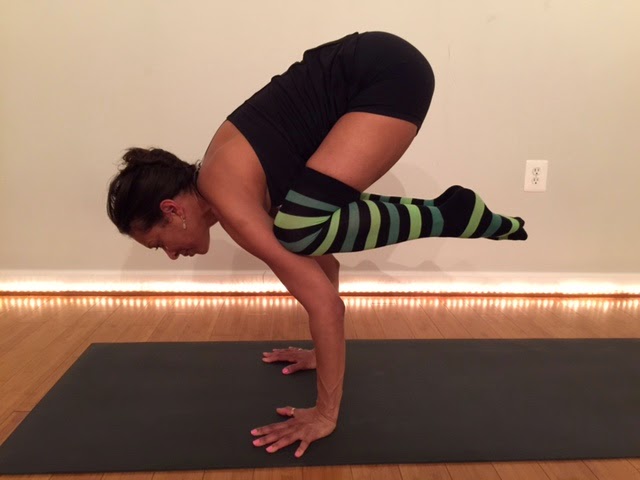
I've been taking some photos and videos of my practice to document post surgery progress mostly, and this photo was taken on St. Patty’s Day.  Found the socks when I was out shoe shopping.  I didn’t’ find any shoes, but the socks were a must have J. 


Monday, June 17, 2013

Thoughts on Kino MacGregor's New Book: The Power of Ashtanga Yoga

Kino MacGregor (Kino) has a way of articulating Ashtanga Yoga that illustrates the power and the subtleties of the practice in a way that is clear, gentile and compassionate in her latest book: The Power of Ashtanga Yoga.  I ordered it through Amazon last month and devoured it when it arrived about a week and a half ago.  A "follower" if you will of her YouTube presence for a couple of years now, I've been drawn to her matter of fact presentation of the practice and her pleasant nature.

Kino's had a 6 day a week practice for 12 years and therefore impressively talks through her YouTube demos with great control.   Further, when she uses models there is a an understatedness about it - almost as though the model isn't really there.   Kino's alignment cues in her vids range from the gross body to the subtle spiritual - a delicate line that she crosses every time with finesse.  Finally, her attire.  My acquisition phase for yoga clothes is waning; however, when I returned from a visit to the Miami Life Center in February I purchased 2 pair of SpaceCat shorts for home practice, and yes, they are worry free.  But enough about why I like Kino, here's what I got from her book.

It's broken into two parts, Theory and Practice.  The second part of the book is an asana guide for Primary Series (Yoga Chikista) followed by appendices on mantras, the vinyasa count and a complete picture guide on Primary.

The fabulous thing about yoga is the infinite amount of time you can spend studying it's varied aspects.  Kino is able to extract majorly complex subject matter points and finely articulates them.  In her Acknowledgements she pays homage to her teacher Sri K. Pattabhi Jois (Jois) and shares that the first yoga classes she took were at the gym at the bendy age of 19.   Her journey in the beginning was no different from the rest of ours in that it was replete with a racing mind, fashion obsession (yoga gear), asana grasping and my personal favorite, injury. 

Here are some of the parts of the Theory chapters I noted.  This section is a short, digestable 56 pages; I'll outline my favorite parts.   Again, yoga is a vast subject and Kino underscores that fact well in the section called "The Ancient Origins of Yoga Poses" where she states:

"While asana developed within the context of the larger philosophy and theory of yoga, it would be incorrect to say that they are the same.  Asana is a subset of yoga and one - perhaps foundational - step in the full eight-limbed path of Ashtanga Yoga." p 5

"The eight-limbed path outlined in Patanjali's yoga Sutras describes the ultimate goal of yoga as final liberation through the steady cultivation of practice and nonattachment, and asana plays a vital role." p6

On Ashtanga as a Spiritual Practice, Kino talks about the 6 poisons (desire, anger, delusion, greed, envy and sloth) and that Jois taught that in order to remove them "...you have to pactice with strong determination and change layers of deeply rooted negative behavioural patters (samskaras) that can be eradicated through yogic purification." p9  I agree that the decision to do a daily practice is in and of itself a transformative one.  In the quest to study with master teachers, some new Ashtangis I've talked to have come to Mysore because they wanted to attend a master class intensive and were told they needed to begin a regular Mysore practice.  I hadn't run across that requirement in my studies but had felt a subtle internal rumbling for about a year that bubbled over when Lent approached in March.  For starters, I'm burning through sloth.  Asanas aside, this phenomenon makes bujapidasana and kurmasana look like a walk in the park.

Which leads into, Ashtanga Physical Practice on page 9.  Kino describes the 6 groups of poses that consist of Primary Series, also known as Yoga Chikista aka gross level detox - and the concept of its progression.   Second or Intermediate also known as Nadi Shodhana or nerve cleansing consists of deeper backbends.  Finally, the Advanced Practice (Third through Sixth Series) are briefly explained if at all;  Kino practices Third and Fourth.

Practicing as much as one can is recommended; 6 days a week minus full and new moon days, Saturdays and ladies holidays.  I've been following this schedule as much as possible.  When an off day rolls around, it's actually hard to not get up early (although not as early as weekday Mysore hours) and practice another form of sadhana, so that's what I do.  There's no TV, phone or iPod at this time of course.

Chapter 2 entitled: Heart of the Method; Breath, Pose and Gaze (Tristanta Method) is where Kino breaks down these three components.  Again, vast subjects which she exceptionally captures in about 15 pages.   Chapter 3 on The Ashtanga Yoga Diet covers vegetarianism and the practice of ahisma or non-harming which forms the first limb of the Ashtanga Yoga eight-limbed path.  She discusses how food rooted to the earth and food reaching closest to the sun impact your internal cleansing, environmental consciousness and physical constitution.

I've chosen a pescatarian diet over the years and haven't had a bite of meat in the past 3 years except when someone slips me a mickey.  Meat began to make me feel sluggish when I began my yoga practice in 2004 but at the time I couldn't put a finger on the cause of my fatigue and bloat.  I just figured that my body was working better! And that my body was tired because I was taking a lot of hot yoga classes.   Gradually I cut out all meats and noticed positive results in my energy levels and gut comfort but held on to chicken and fish.  Then one day Russell Simmons posted a video on chicken processing that I could only watch halfway; therefore beginning the end of my love affair with the bird.

Theory ends with Chapter 4 on The Spiritual Journey of Asana: Yoga Beyond Bending and in classic Kino fashion she hones in on the ultimate; unlocking your potential  through your practice so that you can witness the divine and your own transformation.  "...the physical tansformation you attain through yoga is not the result of targeted toning techniques; instead it occurs when you dissolve and surpass deeply entrenched physcological and emotional patterns; your body changes as your mind evolves." p46   It takes courage on your part as well as a good teacher who "...inspires the student to greatness beyond the boundaries of anything they know to be true." p47

Part 2 on the practice is wonderful pictured asana guide which gives appropriate attention to the alignment cues for each.  Kino's book is truly a handy guide for any yoga teacher and a must have for students in my opinion.